
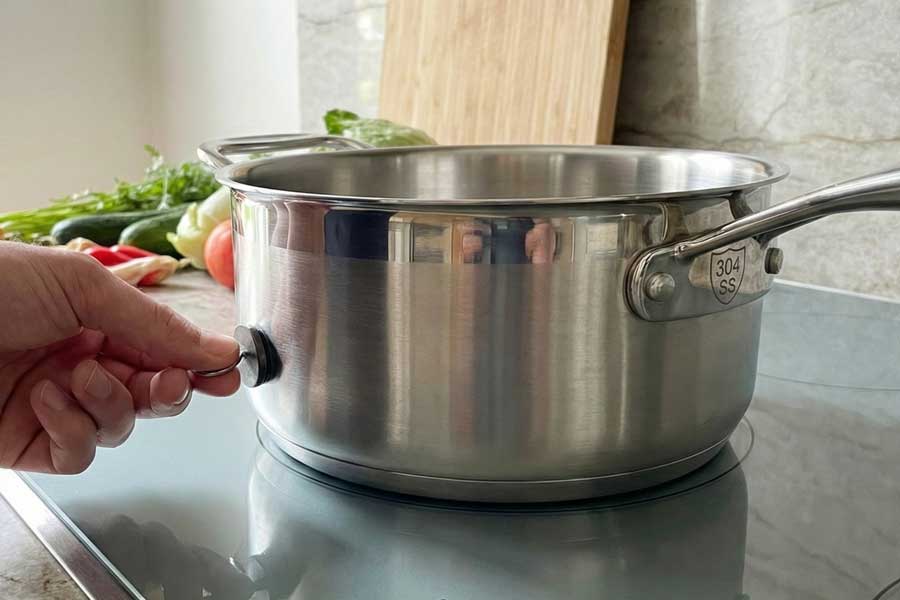
Can Pure 304 Stainless Steel Work on Induction Cooktops?
If you have ever placed a high-quality 304 stainless steel pot on an induction cooktop only to find it doesn’t heat up, you aren’t alone. Understanding why this happens is key to choosing the right cookware for your kitchen.
The Science of Induction Heating
Unlike gas or electric stoves, induction cooktops use electromagnetism. They create a magnetic field that induces an electric current (and thus heat) directly in the cookware. For this to work, the cookware must be ferromagnetic—meaning it must contain enough iron or magnetic material to react to the field.
Is 304 Stainless Steel Magnetic?
304 stainless steel is part of the Austenitic family (18/8 or 18/10). During its production, chromium and nickel are added to provide superior corrosion resistance. This process alters the atomic structure, making pure 304 stainless steel non-magnetic.
Because an induction hob requires a magnetic connection to complete the circuit, a “pure” 304 stainless steel vessel will generally not work. The cooktop will likely display an error code or simply fail to detect the pan.
The Solution: Multi-Ply or Capsulated Bases
Does this mean you can’t use high-quality stainless steel on induction? Not at all! Most modern premium cookware utilizes a “sandwich” design:
Interior Layer: 304 stainless steel for food safety and durability.
Core: Aluminum or copper for heat conductivity.
Bottom Layer: 430 stainless steel (Ferritic), which is magnetic and allows the induction stove to function.
How to Check Your Cookware
To see if your 304 stainless steel pot is induction-compatible, try the Magnet Test:
Take a simple kitchen magnet.
Place it against the bottom of the pot.
If it sticks firmly, it will work on induction. If it falls off, it won’t.
Summary: While pure 304 stainless steel is excellent for food hygiene, it lacks the magnetic properties needed for induction. Always look for the “Induction Ready” symbol when shopping!




nice
Thank you for sharing this! I really enjoyed reading your perspective.